
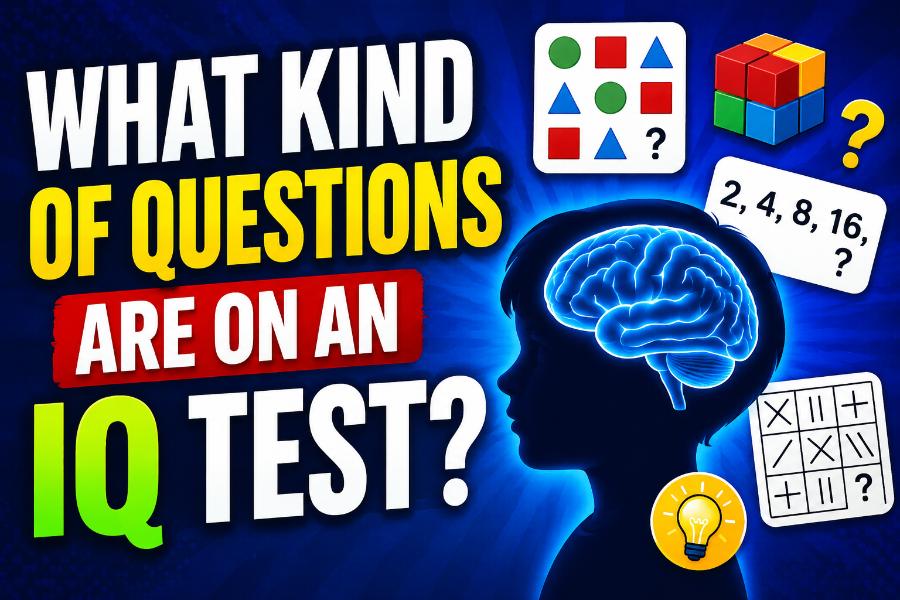
IQ tests are designed to measure different types of cognitive abilities, including logical thinking, problem-solving skills, memory, reasoning ability, and pattern recognition. Many people wonder what kind of questions appear on an IQ test because these assessments are different from traditional school exams.
Unlike a regular test that focuses on memorizing information, an IQ test evaluates how a person thinks and processes new information. The questions are usually created to examine mental skills such as identifying patterns, understanding relationships, solving problems, and making decisions.
IQ tests are commonly used for educational research, psychological assessment, and personal understanding. For children, IQ tests can help identify learning strengths and areas where additional support may be useful.
In this guide, we will explain the different types of questions found on IQ tests, how each question category works, and what skills these questions measure.
What Is an IQ Test?
An IQ test, also known as an intelligence quotient test, is a standardized assessment designed to measure certain cognitive abilities. The goal of an IQ test is not to measure everything about a person’s intelligence but to evaluate specific thinking skills.
Modern IQ tests usually include several sections because intelligence involves many different abilities. A person may be excellent at solving visual puzzles but perform differently on language-based questions.
Common areas measured by IQ tests include:
- Logical reasoning
- Pattern recognition
- Verbal understanding
- Numerical reasoning
- Memory
- Processing speed
- Visual-spatial ability
Each section provides information about how a person approaches different types of problems.
Common Types of Questions on an IQ Test
IQ tests include various question formats to measure different areas of thinking. The exact questions depend on the test being used, but most assessments include similar categories.
1. Pattern Recognition Questions
Pattern recognition is one of the most common types of IQ test questions.
These questions measure how well someone can identify relationships between objects, numbers, or symbols.
A typical pattern question may show a sequence of shapes:
○ △ □ ○ △ ?
The person must determine which shape should come next.
To solve these questions, test takers need to analyze:
- Shape changes
- Size differences
- Position movement
- Rotation
- Color patterns
- Number sequences
Pattern recognition is an important thinking skill because it helps people understand connections between different pieces of information.
Children often encounter pattern questions because they help measure developing reasoning abilities without requiring advanced knowledge.
Example Pattern Question
A sequence shows:
2, 4, 8, 16, ?
The answer is 32 because each number doubles.
This type of question tests whether someone can identify mathematical relationships.
2. Logical Reasoning Questions
Logical reasoning questions evaluate a person’s ability to analyze information and reach conclusions.
These questions do not usually require memorizing facts. Instead, they test how someone thinks through a problem.
Examples of logical reasoning questions include:
- Identifying relationships
- Completing sequences
- Finding missing information
- Understanding cause and effect
- Solving puzzles
Example:
All cats are animals.
Some animals are pets.
Which statement is correct?
The test taker must carefully analyze the information instead of guessing.
Logical reasoning is important in everyday life because people use it when making decisions, solving problems, and understanding situations.
3. Verbal Reasoning Questions
Some IQ tests include questions based on language skills.
Verbal reasoning measures how well a person understands words, meanings, and relationships between concepts.
Common verbal IQ questions include:
- Vocabulary questions
- Word similarities
- Opposite meanings
- Sentence completion
- Verbal classification
Example:
Bird is to Fly as Fish is to:
A) Walk
B) Swim
C) Jump
D) Run
The correct answer is “Swim.”
This question tests understanding of relationships between words.
Verbal reasoning questions are especially useful for measuring communication and comprehension skills.
4. Numerical Reasoning Questions
Numerical reasoning questions involve numbers, calculations, and mathematical patterns.
These questions are not designed to test advanced mathematics. Instead, they focus on understanding numerical relationships.
Common examples include:
- Number sequences
- Missing numbers
- Mathematical patterns
- Basic calculations
Example:
5, 10, 15, 20, ?
The answer is 25 because the numbers increase by five.
Numerical reasoning helps measure problem-solving ability and the ability to recognize mathematical structures.
5. Visual-Spatial Questions
Visual-spatial questions measure how well someone understands objects, shapes, and space.
These questions are common in many professional IQ assessments.
Examples include:
- Rotating objects mentally
- Matching shapes
- Completing visual patterns
- Understanding 2D and 3D objects
Example:
A test may show a folded paper shape and ask what it would look like when opened.
These questions measure the ability to imagine objects and understand spatial relationships.
Visual-spatial skills are useful in many fields, including:
- Engineering
- Architecture
- Design
- Technology
- Science
6. Memory-Based Questions
Some IQ tests include memory-related tasks.
These questions examine how well a person can store and recall information.
Examples include:
- Remembering numbers
- Repeating sequences
- Matching information
- Remembering images
Memory plays an important role in learning and problem-solving because people need to remember information while working through challenges.
7. Processing Speed Questions
Processing speed questions measure how quickly someone can understand and respond to information.
These questions often involve:
- Matching symbols
- Identifying differences
- Completing simple tasks quickly
The goal is not only accuracy but also how efficiently someone processes information.
Processing speed is important because many daily activities require quick thinking and decision-making.
Are IQ Test Questions the Same for Everyone?
No, IQ test questions can vary depending on several factors.
Different IQ tests are designed for different age groups and purposes.
For example:
Children’s IQ Tests
Children’s IQ tests often include:
- Picture puzzles
- Simple patterns
- Matching activities
- Memory games
- Basic reasoning problems
These questions are designed to measure developing cognitive skills.
Adult IQ Tests
Adult assessments may include:
- More complex reasoning
- Advanced patterns
- Verbal analysis
- Abstract thinking problems
The difficulty level changes depending on the person’s age and ability level.
Do IQ Tests Measure Intelligence Completely?
Although IQ tests measure important thinking skills, they do not measure every type of intelligence.
A person’s IQ score does not fully represent:
- Creativity
- Emotional intelligence
- Leadership ability
- Social skills
- Practical experience
- Motivation
For example, someone may have average IQ results but excellent creativity or communication skills.
Intelligence is a broad concept, and IQ tests measure only certain areas.
How Can You Prepare for IQ Test Questions?
While IQ tests are designed to measure natural reasoning abilities, preparation can help people become familiar with question styles.
Helpful preparation activities include:
Practice Logic Puzzles
Logic games help improve analytical thinking and problem-solving skills.
Improve Pattern Recognition
Try activities involving:
- Number sequences
- Shape puzzles
- Matching games
Practice Memory Exercises
Memory games can help improve concentration and recall ability.
Stay Relaxed During Testing
Stress can affect performance. A calm mind helps people think more clearly.
Get Enough Sleep
Rest is important because concentration and problem-solving depend on mental energy.
Why Are IQ Test Questions Important?
IQ test questions provide information about how people approach problems.
They help researchers and educators understand:
- Learning abilities
- Reasoning strengths
- Cognitive development
- Problem-solving approaches
For children, IQ testing may help parents and teachers understand educational needs.
For adults, IQ assessments can provide insight into certain cognitive strengths.
Frequently Asked Questions About IQ Test Questions
What kind of questions are on an IQ test?
IQ tests usually include pattern recognition, logical reasoning, verbal questions, numerical problems, memory tasks, and visual-spatial puzzles.
Are IQ test questions difficult?
The difficulty depends on the test level. Some questions are simple, while others require advanced reasoning.
Can children take IQ tests?
Yes. Many IQ tests are specifically designed for children and measure age-appropriate thinking skills.
Do IQ tests require math skills?
Some IQ tests include numbers, but most focus more on reasoning and problem-solving than advanced mathematics.
Can practicing IQ questions improve results?
Practice can improve familiarity with question formats and increase confidence, although it does not guarantee a higher intelligence score.
Final Thoughts
IQ tests include many different types of questions designed to measure reasoning, problem-solving, memory, and cognitive abilities. Common question categories include patterns, logic, verbal reasoning, numerical thinking, and visual puzzles.
Understanding what kind of questions appear on an IQ test can help reduce stress and make the testing experience easier. Preparation, practice, and confidence can help people perform at their best.
However, an IQ score represents only one part of intelligence. Every person has unique abilities, talents, and strengths that go beyond a single test result.
IQ tests are valuable tools for understanding certain thinking skills, but they should always be viewed as one piece of the larger picture of human ability.