
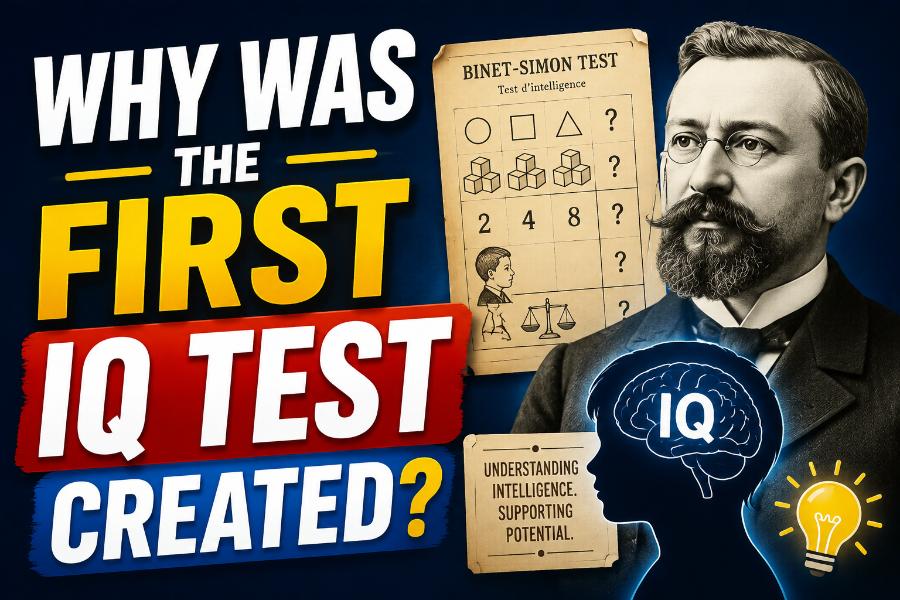
Why was the first IQ test created? The original intelligence test was developed to identify schoolchildren who needed additional educational support. It was not initially designed to rank people, identify geniuses, determine career success, or place permanent limits on a child’s potential.
In the early 1900s, France was working to provide formal education to all children. As more students entered public schools, teachers encountered children who had difficulty keeping up with standard classroom lessons. Educators needed a more reliable way to determine which children required specialized instruction.
French psychologist Alfred Binet and physician Théodore Simon responded to this educational problem by developing a series of tasks that evaluated abilities such as memory, attention, reasoning, comprehension, and problem-solving. Their work became known as the Binet-Simon Intelligence Scale.
An early version of the scale appeared in 1905, followed by important revisions in 1908 and 1911. Modern historical research emphasizes that the test was a joint achievement by Binet and Simon rather than the work of Binet alone. The more complete 1908 version organized tasks by age and more closely resembled the intelligence-testing system described in modern psychology books.
Although their assessment eventually became the foundation of modern IQ testing, Binet and Simon had a practical and compassionate objective: to help children receive appropriate instruction.
The Educational Problem That Led to the First IQ Test
To understand why the first IQ test was created, it is necessary to understand what was happening in French education at the time.
France had introduced compulsory primary education during the late nineteenth century. Children between approximately six and thirteen years old were expected to attend school. Universal education was an important social achievement, but it also presented teachers and administrators with new challenges.
Before compulsory education, children who struggled academically might leave school or never attend consistently. Once attendance became mandatory, schools had to educate children with a much wider range of learning abilities, developmental needs, and personal circumstances.
Some students learned quickly through traditional teaching methods. Others required more time, different explanations, smaller classes, or individualized support. Teachers could observe that certain children were struggling, but observation alone could be inconsistent.
A child might perform poorly for many reasons, including:
- Limited previous education
- Language difficulties
- Poor health or nutrition
- Anxiety or lack of confidence
- Hearing or vision problems
- Inadequate teaching
- Developmental differences
- Intellectual disabilities
- Difficult family circumstances
Educators therefore needed a structured method for distinguishing between a temporary academic difficulty and a more significant developmental need.
Binet and Simon attempted to create that method.
Who Created the First Intelligence Test?
The first widely recognized practical intelligence test was created by Alfred Binet and Théodore Simon in France.
Alfred Binet was a psychologist who studied memory, attention, judgment, imagination, and childhood development. He was interested in the complex mental processes involved in intelligent behavior.
Théodore Simon was a physician with experience working with children and patients who had intellectual or developmental difficulties. His clinical knowledge was extremely important to the project.
Popular accounts frequently describe Binet as the sole inventor of intelligence testing, with Simon presented only as an assistant. However, historical evidence shows that the scale resulted from close collaboration between the two researchers. Recent scholarship argues that Simon’s contribution has often been unfairly minimized in psychology textbooks.
Their combined expertise allowed them to approach intelligence from both psychological and practical perspectives.
Was Alfred Binet Hired by the French Government?
A commonly repeated story says that the French Ministry of Education directly hired or commissioned Alfred Binet to invent an intelligence test.
The real history is more complicated.
Binet participated in organizations and committees concerned with children’s education and psychological development. He was involved with the Free Society for the Psychological Study of Children, an organization that examined how schools could better understand and support children.
A ministerial commission was formed to study the education of children who were unable to follow ordinary instruction. Binet and Simon’s work became connected to this effort, but recent historical analysis concludes that the French government did not simply hire Binet and ask him to create an IQ test.
Instead, the test emerged from broader debates about compulsory schooling, special education, psychiatric institutions, and the fair treatment of children who experienced learning difficulties.
This distinction matters because it shows that intelligence testing did not begin as a commercial product or a national ranking system. It developed from a practical educational and social problem.
What Was the Original Purpose of the First IQ Test?
The original purpose of the first intelligence test was to identify children who might need specialized education or remedial instruction.
Binet and Simon wanted to examine how a child thought rather than simply test what the child had memorized at school. A traditional classroom examination might show whether a student knew arithmetic facts or spelling rules, but it could not always show why the student was struggling.
Their assessment included tasks that examined mental processes such as:
- Remembering information
- Following directions
- Recognizing objects
- Understanding questions
- Comparing ideas
- Completing sentences
- Solving simple problems
- Making practical judgments
- Paying attention
- Reasoning with words and concepts
These tasks were intended to provide a broader picture of a child’s intellectual development.
The goal was not to punish children who performed poorly. The results were supposed to help educators decide who needed extra assistance and what type of instruction might be appropriate.
What Did the First Intelligence Test Look Like?
The earliest Binet-Simon scale was very different from many online IQ quizzes available today.
The 1905 version contained a collection of tasks arranged roughly from easier to more difficult. The assessment was usually administered individually, allowing the examiner to observe how the child understood instructions and approached each problem.
The tasks did not consist entirely of mathematics. They examined different forms of mental activity.
A younger child might be asked to name familiar objects, repeat a short series of numbers, follow a basic instruction, or identify parts of the body.
An older child might be asked to define words, explain differences between objects, remember longer sequences, understand abstract questions, or solve practical reasoning problems.
The 1908 revision represented a major development. Binet and Simon grouped tasks according to the ages at which children typically completed them. The scale included several tasks for different age levels, beginning with young children and progressing to more difficult items for older children.
This age-based organization helped examiners compare a child’s performance with the typical performance of children of a similar age.
How Did the Idea of Mental Age Develop?
One of the most influential ideas associated with the Binet-Simon scale was mental age.
Mental age described the general age level represented by a child’s test performance. For example, suppose an eight-year-old child successfully completed tasks usually passed by eight-year-olds. The child’s mental age would be considered close to eight.
If the same child mainly completed tasks commonly passed by six-year-olds, the results might suggest that the child was developing more slowly in the abilities measured by the test.
This comparison gave educators a more understandable way to interpret performance than a simple total of correct and incorrect answers.
However, mental age was not intended to describe every part of a child’s personality, talent, creativity, motivation, or future. It represented performance on a particular set of tasks under particular testing conditions.
The concept became highly influential in developmental psychology and later contributed to the calculation of intelligence quotients.
Was the First Test Actually an IQ Test?
Technically, the original Binet-Simon scale was not an IQ test in the modern sense.
It was an intelligence scale created to estimate a child’s level of intellectual development. The term “intelligence quotient,” commonly shortened to IQ, was introduced later.
German psychologist William Stern proposed comparing mental age with chronological age. The traditional IQ calculation divided mental age by chronological age and multiplied the result by 100.
For example:
Mental age ÷ chronological age × 100 = IQ
If a ten-year-old child had a mental age of ten, the calculation produced an IQ of 100.
American psychologist Lewis Terman later adapted the Binet-Simon scale at Stanford University. His version, published in 1916, became known as the Stanford-Binet Intelligence Scale and helped popularize the IQ score in the United States.
Therefore, when people ask why the first IQ test was created, they are usually referring to the Binet-Simon scale, even though the original assessment did not use modern IQ scoring.
Binet Did Not Believe Intelligence Was Permanently Fixed
One of the most important facts about the first intelligence test is that Binet did not intend a test score to become a permanent label.
He recognized that intellectual performance could be affected by education, practice, motivation, health, environment, and opportunity. He believed children who struggled could often improve when they received appropriate teaching.
This belief was closely connected to the test’s educational purpose.
A low result was supposed to signal that a child needed assistance. It was not supposed to prove that the child could never learn, achieve goals, develop new skills, or live a successful life.
This original philosophy remains relevant today. A professionally administered cognitive assessment can provide useful information, but it should be interpreted together with educational history, behavior, language background, health, motivation, and other evidence.
No single number can fully describe a person.
How the First IQ Test Changed Education
The Binet-Simon scale introduced a more systematic approach to evaluating children’s learning needs.
Before standardized assessments, educational decisions were often based heavily on teacher opinion, medical judgment, behavior, social background, or assumptions about a child’s family.
A structured test offered the possibility of making decisions using consistent tasks and comparisons. It could help schools recognize that some children were not simply lazy, disobedient, or unwilling to learn. They might need a different pace or type of instruction.
The test also contributed to the development of school psychology, special education, psychological assessment, and developmental research.
Its descendants are still used to help professionals:
- Identify intellectual disabilities
- Evaluate developmental delays
- Recognize giftedness
- Understand cognitive strengths and weaknesses
- Plan educational support
- Investigate learning difficulties
- Conduct psychological research
Modern tests are much more carefully standardized than the first Binet-Simon scale, but they continue to reflect its basic idea: performance on selected tasks can provide information about cognitive functioning.
How Intelligence Testing Spread to the United States
The Binet-Simon scale attracted international attention soon after its publication.
American researchers translated, modified, and expanded it. Lewis Terman’s Stanford revision became one of the most influential versions.
The Stanford-Binet assessment expanded the age range and was increasingly used to measure both learning difficulties and above-average ability. Unlike Binet’s original educational focus, American adaptations were often used for wider classification and selection purposes.
During World War I, group intelligence tests were also developed for military recruits. These tests made it possible to assess large numbers of people more quickly than individual examinations.
Intelligence testing subsequently spread into schools, universities, workplaces, immigration systems, hospitals, and government programs.
This expansion transformed a tool created to help struggling French schoolchildren into a major international system of psychological measurement.
How IQ Tests Were Misused
The history of IQ testing includes serious controversies.
Although the first scale was created to guide educational assistance, later intelligence tests were sometimes used to support discrimination, segregation, forced sterilization, restrictive immigration policies, and eugenic theories.
Some researchers treated intelligence scores as permanent evidence of a person’s biological value. Cultural, linguistic, educational, and economic differences were frequently ignored.
A person unfamiliar with the test’s language or cultural assumptions could receive a low result that did not accurately represent their reasoning ability. Testing conditions and access to education could also influence performance.
These practices moved far away from the original goal of identifying children who needed help.
The history demonstrates that a psychological test is not automatically fair simply because it produces a number. Its quality depends on how it is designed, standardized, administered, interpreted, and used.
How Modern IQ Tests Differ From the First Test
Modern intelligence tests are more advanced than the original Binet-Simon scale.
Professional assessments are standardized using large groups of participants. Scores are generally compared with results from people in the same age group. Test developers also examine reliability, validity, fairness, and potential cultural bias.
Modern assessments may measure several areas, including:
- Verbal comprehension
- Visual-spatial processing
- Fluid reasoning
- Working memory
- Processing speed
- Quantitative reasoning
- General knowledge
Instead of relying only on one total score, psychologists may examine a profile of results. This can reveal that a person has strong reasoning skills but slower processing speed, or strong visual abilities but difficulty with working memory.
Modern IQ tests generally use deviation scoring. A score of 100 represents the average performance of the relevant age group rather than a direct mental-age calculation.
Even with these improvements, modern tests do not measure every valuable human ability. Creativity, emotional understanding, persistence, curiosity, practical judgment, artistic talent, social ability, and personal character cannot be completely summarized by an IQ score.
Why the Original Purpose Still Matters
Understanding why the first IQ test was created changes how intelligence testing should be viewed.
The first practical intelligence scale was primarily an educational support tool. Its creators wanted to identify children who could benefit from additional attention and specialized teaching.
This history provides several important lessons.
An IQ Score Should Guide Support
A score should help educators and psychologists understand what assistance may be useful. It should not be used to shame a child or reduce expectations without considering other evidence.
Intelligence Is More Than One Number
A test samples selected cognitive abilities. It does not measure the full value, potential, personality, or future of the person taking it.
Testing Requires Professional Interpretation
A result can be affected by language, anxiety, attention, health, testing conditions, cultural experience, and familiarity with certain tasks.
Children Can Develop
Cognitive skills are influenced by learning and experience. Supportive teaching, practice, sleep, nutrition, confidence, and access to educational resources can all contribute to performance.
Tests Must Be Used Responsibly
The misuse of intelligence testing shows why ethical standards, fair assessment methods, and careful interpretation are essential.
What Was the Main Reason the First IQ Test Was Created?
The main reason the first IQ test was created was to identify children who were struggling in ordinary classrooms and determine who might benefit from special educational support.
Binet and Simon wanted to replace unreliable assumptions with a more structured evaluation of mental processes. They assessed abilities related to memory, attention, understanding, judgment, and reasoning.
Their test was not originally intended to identify the smartest child in a classroom or divide society into permanent intellectual categories.
It was created to answer a practical question: Which children need additional help to learn effectively?
Frequently Asked Questions
Who invented the first IQ test?
Alfred Binet and Théodore Simon developed the first widely recognized practical intelligence scale in France. An early version was published in 1905, with major revisions in 1908 and 1911.
Why was the first IQ test created?
The first IQ test was created to identify schoolchildren who needed additional educational support or specialized instruction.
What was the first IQ test called?
It was called the Binet-Simon Intelligence Scale. The name recognized the contributions of Alfred Binet and Théodore Simon.
When was the first IQ test created?
The first version of the Binet-Simon scale was published in 1905. A more complete age-based version appeared in 1908.
Did Alfred Binet invent the IQ score?
No. Binet helped develop the first practical intelligence scale, but the intelligence quotient concept and IQ formula were introduced later.
Was the original IQ test designed to find gifted children?
No. Its primary purpose was to identify children who had difficulty with ordinary classroom instruction and might need additional support.
Did Binet believe IQ could never change?
No. Binet did not consider intelligence-test performance an unchangeable measure of a person’s potential. He believed education and intervention could help children improve.
Are modern IQ tests the same as the original test?
No. Modern tests use more extensive standardization, updated scoring systems, multiple cognitive areas, and stronger professional guidelines.
Final Thoughts
So, why was the first IQ test created? It was created to help educators identify children who needed additional support in school.
Alfred Binet and Théodore Simon developed their intelligence scale in response to the challenges created by compulsory education in France. Their assessment examined memory, attention, comprehension, judgment, and reasoning rather than depending only on school knowledge.
The original test was designed as a diagnostic educational tool, not as a permanent judgment of human worth. Binet and Simon wanted the results to lead to better teaching and more appropriate assistance.
Later adaptations introduced the IQ score and expanded intelligence testing into many areas of society. Some applications improved educational and psychological services, while others resulted in discrimination and harmful classification.
The history of the first IQ test therefore offers an important reminder: intelligence assessments are most valuable when they are used carefully, ethically, and in combination with a complete understanding of the individual.
An IQ score may provide useful information about certain cognitive abilities, but it cannot measure every talent, predict every achievement, or define a person’s potential.